
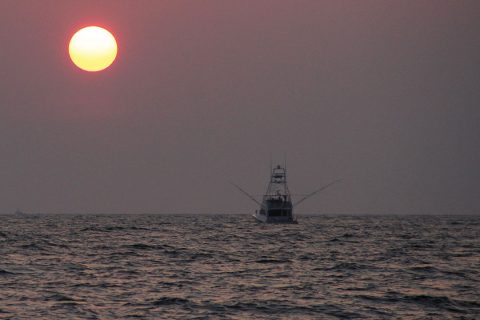
It was almost midnight and the big yellowfin tuna were really active. I’d just finished a “hook and lose” on my third 100-plus-pound yellowfin and my new gaff was gone. I was alone on my boat, Opus III, fishing the west side of the Fish Tails. The evening had been a series of disasters, the last almost deadly. It was a real learning experience.
I learned to fish, like many anglers, from my dad. He died many years ago, but his teaching continues. We shared few words when I was young — he spoke and I listened. I learned a lot sitting in the bow of our small oak skiff. Much of it I learned in silence, including an awareness of the surroundings, the need to be prepared, patience, and the value of a positive response. Miss any of those areas when you’re fishing and your success will be limited; miss any when you’re fishing alone for big fish and you could be dead.
The Coast Guard says, and with good cause, that going to sea alone is unsafe. I enjoy the company of almost anyone when I’m fishing, but hell, when it gets right down to it, fishing is a solitary activity and that’s the way it does me the most good: uninterrupted, alone, detached from the civility of human interaction. I’m certain that I’m not alone in that view. Fishing provides the opportunity to get away from it all. It offers a time to reflect on the mundane, the surreal and to dream the exotic. Going to sea alone has its risks, as the Coast Guard says, but so does any one of a hundred other routine recreational activities. What are sky or bungee jumping, auto racing, mountaineering or deep-water diving, if not risky? We accept a degree of risk to satisfy our desires and, in the case of fishing, for me going solo is very satisfying.
I’ve fished with anglers who fish alone even when someone else is with them. I’ve seen them grab a rod and begin to fight a tuna when they were well aware that it wasn’t their turn. Even when fellow anglers tried to wrest the rod free they continued to protest. When trolling with wire for stripers in others’ boats, I’ve seen them cut the engine as soon as they hooked up, forgetting altogether that there were other anglers with lines in the water. No doubles there. It seems that you don’t have to be alone to be self-absorbed; however, I find it far easier to be so when I’m solo.
The overnight trip to the Fish Tails was my first solo excursion to the canyons. On previous trips, when I had company, we drifted along the temperature breaks, but on this occasion, because I was alone, I joined the group tied off on the high fliers on the west side of the Fish Tails along the 100-fathom curve. A boat with deck lights glaring and half a dozen anglers on board was tied off about 100 yards to my starboard and another about 200 yards to port.
I set a submersible halogen light as a bait attractor off the starboard side amidships and rigged three 50-class International standup outfits. I put two baits out on balloons, one down to 125 feet off the port side, a second at about 75 feet off the port quarter. The third bait I free-lined off the starboard quarter. I had the harpoon rigged with a sharp dart and at the ready against the port side tower ladder. Lines were tied off in both corners ready to snap to the dart line. My new gaff was hanging off the starboard ladder and a tail line was laid out on the cockpit seat. I had my fighting belt and harness on and was ready to set a hook and join the battle. I had heeded my Dad’s advice — at least I thought I had. I was aware of my surroundings, I had prepared for action, I had the patience to fish through the night, and I definitely was ready to act in a positive manner to whatever took my baits.
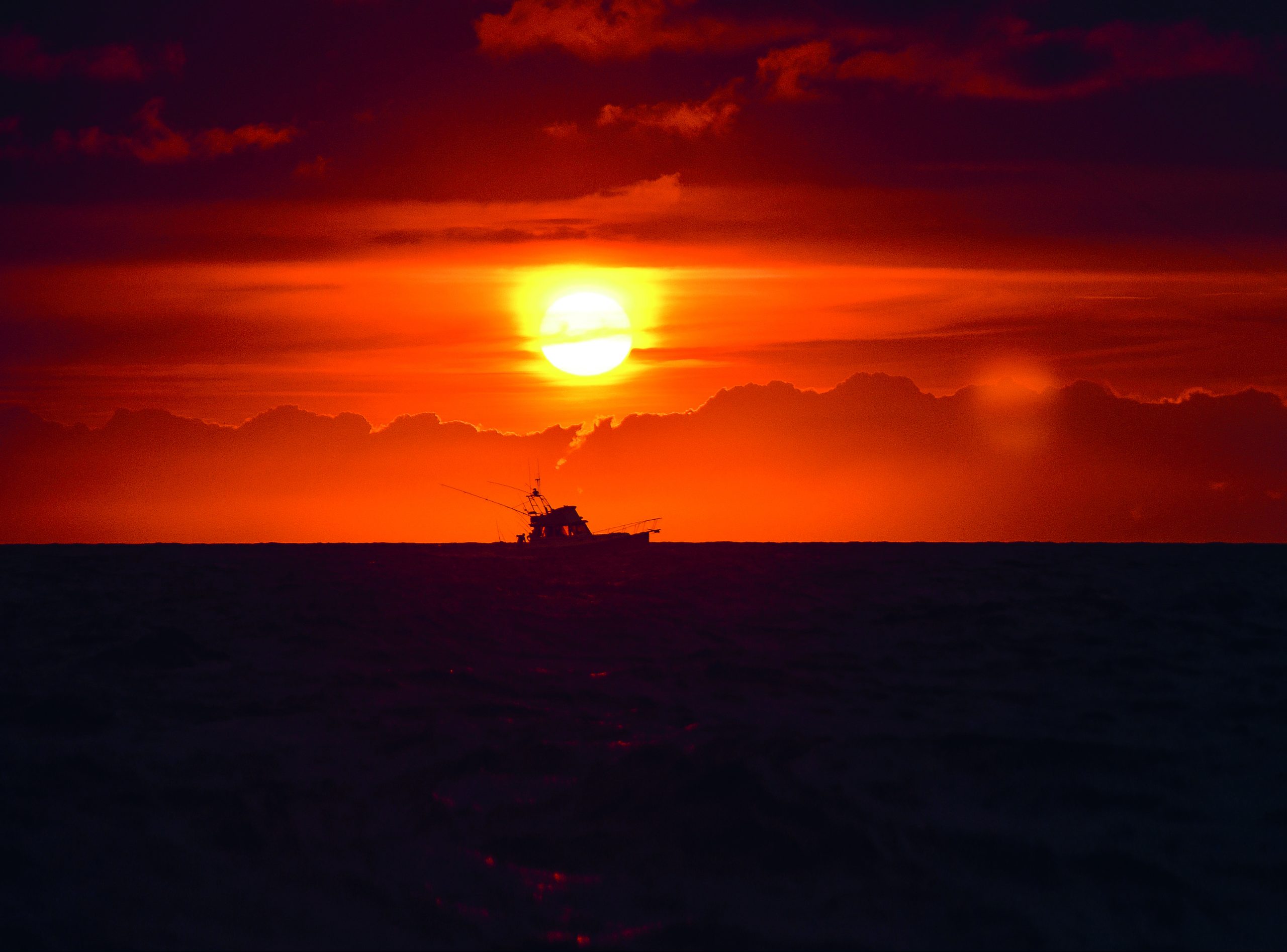
The halogen light had attracted a few squid and I began chumming with butterfish chunks. Now all I had to do was wait. It wouldn’t be long. The boat to starboard had the first action shortly after dark. I had my first hookup about ten minutes later.
The big yellowfin hit the bait that I was free-lining and took off in true tuna fashion, 40 miles-per-hour straight up the starboard side. It ripped line non-stop, made a turn around the highflier, which immediately cut the line. Clearly the tuna had practiced the maneuver. The whole event took a little over a minute. Chalk one up for the fish. Chalk one up for drifting.
I’d lost about 50 yards of line, but there was still plenty to rig again. Once re-rigged, I again free-lined the bait and continued to chunk. Five minutes hadn’t passed when the drag on the same rod began screaming again. I set the hook and had the fighting harness halfway attached when the fish went across the stern to the port side and then forward. By the time I’d passed the rod around the other two that were in the holders on the port side, the fish had crossed under the boat. I could feel the line rubbing on the bottom, and even backing off the drag didn’t keep it from finally breaking. The reel was half spooled, so I had to rig another outfit.
For a third time the free-lined bait was out and I was primed. The boat to starboard was still catching fish and I was hot for another chance. Once again it was only a few minutes before the sweet music of the drag called for action. This time the big yellowfin was more cooperative. He went straight out from the starboard quarter. I had the hook set, the rod gimbal seated in the fighting belt and the harness snapped onto the reel. About 15 minutes later the fish was in its final round, circling off the starboard corner lying on its right side. It was a good fish in the 120- or 130-pound class. This beauty would be mine — mine alone.
Scratch plan one, the harpoon was on the port side and out of reach. I picked up the gaff and thought through the process I’d use to bring the fish aboard. I would stand upright with the harness holding the fish and thereby freeing my arms. When the tuna circled by I would quickly bend over and gaff it. Sounded good to me, so I executed the quick lean over the gunwale, set the gaff and wham! The tuna took off with a ton of energy with me half out of the boat trying to hang onto the gaff. I was heading for the water.
Given the alternative, I let go of the gaff and tried to fall onto the deck of the boat. Before I was fully behind the gunwale the fish hit the end of the slack line and with the sound of a .22-caliber pistol, snapped it. Thank God. My heart was pounding. It was an exhilarating experience. I survived.
Without a safety line attached to the reel and anchored to the boat, I was at risk of going into the water and being pulled down by the fish. Day or night that’s bad, but it’s really bad when you’re by yourself. Even if I could have gotten myself separated from the fish I would have been drifting away from the boat without any flotation. What an idiot — alone at night and not wearing a life jacket. I’d had enough and called it a night.
Now came the part I hadn’t thought of at all. I needed some sleep, but who would take the watch with my eyes closed? I lay down on the cabin deck close to the hatch having left the anchor light and deck lights on and dozed off to a restless sleep. I woke up to the sound of people talking and a grouping of bright lights off the stern. I had come loose from the high flier I had tied to and drifted across the Fish Tails into the fleet that was tied off on the east side. It was a fitting departure from the west bank, given the evening’s events.
I’m making a list of things I need to do to better prepare myself for the solo trips I’ll be making offshore this year. If I live through enough experiences, I may write a “how to” article instead of a “how not to.”
As an aside to this story, I trolled the first two hours of daylight before heading home and boated a nice yellowfin and an albacore that dressed out at 83 and 52 pounds, respectively. But then, trolling seven lines when you’re alone is another story.
Originally published in On The Water magazine, September 2002.
Captain,
You’ve provided a great lessons learned. Your experience and common sense kept you alive and brought you home safely, thankfully.
I hope others will learn from you too, particularly the value of having two anglers when offshore.
Here’s hoping we might cross some day.
Art Howe
Outdoor safety consultant/instructor